
Why an Aquarium?
An aquarium can be a relaxing addition to a home. There is even scientific research that recognises this.
see New study finds aquariums deliver health benefits as one example.
It may also be your child's first interaction with living creatures, presenting far less risk than many other pets. The question of decoration and selection of the fish themselves will determine how the tank fits into your lifestyle. A random collection of objects in water with a few single fish swimming around may not be the vision that you have in mind. A beginner may well, and probably will make some errors at the start. I hope this page will help minimise these and lead to years of pleasure from this hobby.
Choosing your aquarium
Get a set!
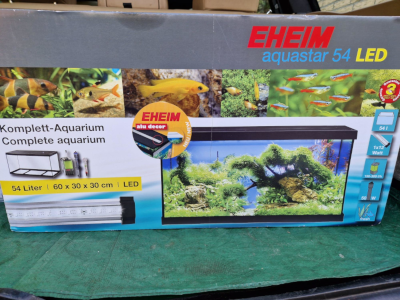
Most starter sets will save you money BUT then you will get all the components from one manufacturer. So you need a reputable manufacturer. A non-exclusive, alphabetical list might include: Aquael, Aquaatlantis, Diversa, Eheim, Fluval, Juwel, Marina, Oase, Sera. Most will have dealers nearby, who hopefully will stock consumable parts, for your filter etc.
Sets usually include a filter, a heater and a cover with lighting.
The smallest standard set is 60cm x 30cm x 30cm (24" x 12" x 12"). This is the smallest length recommended for fish. Even the smallest 'nano' fish can be active swimmers and need the space. There are larger sets and also complete aquariums up to a couple of hundred litres if that is what you want. Shrimp-only sets can also be interesting, they can be much smaller.
A no-name set may be fine, and save you money at the start, but will you still be able to get replacement filter elements in 10 years' time? Or a replacement light out of guarantee?
Get a place
Whilst you're thinking about which aquarium, where will it go?
Firstly, away from hours of direct sunlight, this encourages algae. Next you need a place where you can see it, maybe to sit in front of it and relax, so not next to the TV. A bit of room to do your cleaning, and not too far away from a sink or bath either.
There are flatpak stands from most manufacturers, designed to take the load. Some tanks will also fit on a (Swedish) cupboard you already have. Just bear in mind that even a small aquarium can weigh quite a lot. Maybe 50kg water, plus rocks and gravel, the glass itself and the cover. It also makes sense to have a level site, or a stand/ cupboard that can be levelled. Or you place small blocks strategically under the stand.
When the aquarium is finally set up, you will not then be moving it in a hurry! Try different positions in the room whilst it is still empty of water. Check out your decision with family members if they are also interested in the project.
What else at the start?
- A good beginners' book
- Gravel. Not usually included. Some dealers will recommend a layer of extra fertiliser/ soil/ substrate, whatever the maker calls it, under the gravel to act as a long lasting plant fertiliser. Is useful, but I am hesitant to tell you to add this to your list. It is ok for a speciality 'aquascaping' setup, otherwise it is just an added complication. Read up on it and decide yourself. It should not be rinsed!
- Rock and wood decoration. Get these from your dealer. You can choose better than ordering online. Suppliers will sell you suitable pieces which should be aquarium-safe.
Decoration not intended for aquariums may release undesirable substances into the water, this includes rocks and wood you may have collected yourself. Other decoration such as pirate ships, treasure chests may be fun at first, but may also release chemicals into the water long-term. If your plants grow well, they won't be visible after a time. Plastic- coated gravel in bright colours just competes with the fish colours. Fish like to swim over a gravel that isn't glowing bright blue or yellow, but rather in a subdued colour. How much stress this causes is unknown. Get a medium-fine stony gravel, or a particular favourite of mine is 'Manado', the reddish-brown variety. So long as it doesn't have sharp edges to hurt your catfishes' barbels, then it should be ok. - A mat for under the aquarium, where glass would otherwise make direct contact with the stand surface. Note that some makes (e.g. Juwel) have a plastic frame under the tank and should be placed directly on the stand.
- A bucket, one just for aquarium use. This will ensure that neither detergents nor anything other foreign substances will ever get into your water
- Bacteria starter culture and a bottle of water treatment if not in the set.
- A pack of test strips, will tell you easily the state of your water. In particular the progress of the bacteria, and whether anything is amiss.
- A time switch for the lights
Cleaning and Preparation
The Aquarium
may look sparkling, but you need to be sure there is nothing to harm the later inhabitants. A rinse out with clean water would be advisable. Nothing in the water! The only thing you might ever use would be alcohol or vinegar.
You could assemble the filter and give the filter medium a quick rinse but fix it later in place.
The Cupboard/ Stand
Assemble if necessary, set it up in place, and when satisfied, level it up. Wipe over the top of the stand to be sure it is clear of any specks of dirt, place the mat on top if used and place the aquarium on top and level the whole thing up again, this is easier with 2 persons. Only when you are happy with the placing of the aquarium-stand combination should you start with the next stage:
Gravel
In stages, in your aquarium bucket, wash the gravel, under running water if needed, until the water becomes fairly clear, you will never manage 100%! I would always do the final rinses with cold water, just in case there is copper present from the hot water.
Once the gravel substrate is in, you can model it into shape, at least provisionally
Decoration
Rocks
Should be rinsed. Some books recommend testing the rocks for calcium carbonate content. Bought rocks should be ok. If they add hardness to the water at all, it should be minimal. Place the rocks as you like, trying to make some sort of formation. Check out some photos online for ideas. Remodel the gravel now if you like
Wood
Wood can be pre-soaked. Otherwise it should be rinsed and at least temporarily weighed down with a rock. Most fresh wood tends to float. Don't bury it, it may rot.
Plants
Have you already bought some plants? You can put them in now, or wait until the water is in. Any plants to be fixed to the wood, they should be glued now. If time passes before the tank is filled, just spray these every so often.
Adding the Water etc.
Either a saucer, a piece of plastic sheet or even kitchen paper can be placed on the gravel and now add cold water steadily by the bucketful. Check for leaks, it would be extremely unusual if you were to find one, it just doesn't occur these days. You can now put the filter and heater in place and once they are under water, they can be switched on.
Unless you are going to change the water again in between, you could now add the initial water treatment. This binds any chlorine treatment as well as copper in the tap water. Add the bacteria following the manufacturers' instructions. Keep any other additives to a minimum. There are also additives to enable you to start putting in fish almost immediately. To be honest, patience is better. Once the water is in, and the plants, you can have some idea how everything is looking. Move things around now. Don't forget, hands should be clean AND soap- free. Cover on and lights on! Set the timer to about 12 hours.
Plants
If you can wait, do it, the bacteria culture will ensure the filter is working. If using test strips, you may see a nitrite or ammonium peak, which then returns to near zero. This is normal and may take up to 3 weeks. In the mean time see how the plants are growing. Some plants will have been grown emersed, that is not actually in water. This is because a lot of aquarium plants are actually sump plants. The shock of being completely submerged may cause some leaves to die, but new ones should be replacing them. You should also have chosen a bunch or two of fast-growing plants. These can compete for nutrients with algae (always present in water) so the algae do not become your main plants!
Which fish?
Go around your local dealers. Do any often have dead fish in their tanks. Naturally that can happen, but that they are left lying on the bottom and not removed along with dirty tanks shows a lack of care.Do they have a good selection for you? Have you read up on some fish? Any particular ones that interest you? Many tetras and rasboras make a nice group, and interact with each other when in numbers. Make just one variety your main swarm. They will usually occupy the upper to mid water regions.
Livebearers like guppies, mollies and platies are bright and interesting. They will also have babies. When that happens, you will then need another tank (just saying). They are not always so easy to sell, or give away.
A pair of Honey Gouramis are a good addition to any tank, as are the rather larger pearl gouramis. Dwarf gouramis have the reputation of being a bit more aggresive, and I haven't seen any really healthy looking specimens for a long time.
Catfish, the small armoured sort. Were mainly in the Corydoras genus, but now have been reclassified. You'll know them when you see them, busy on the bottom often in twos or threes, happily feeding and minding their own business. Don't get one alone, they are social animals, 3 or 4 would be best.
- .
- .
Other Values
Sorry, not that far yet.